Semi-Key Date · Philadelphia Mint Only
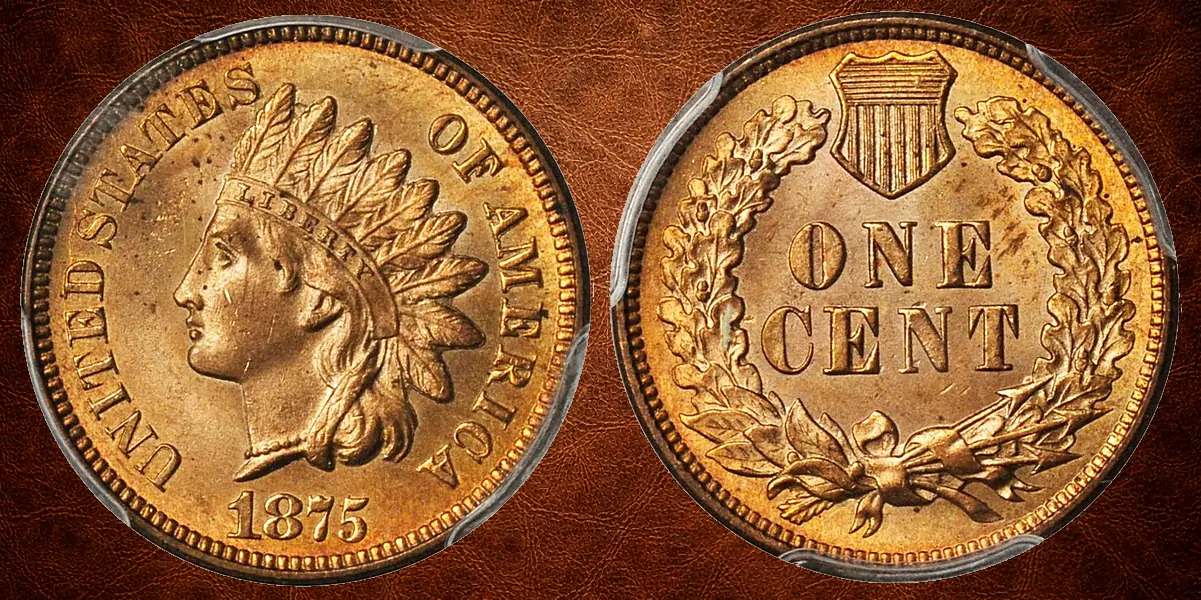
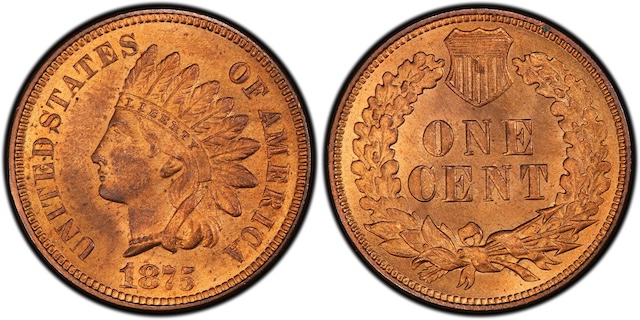
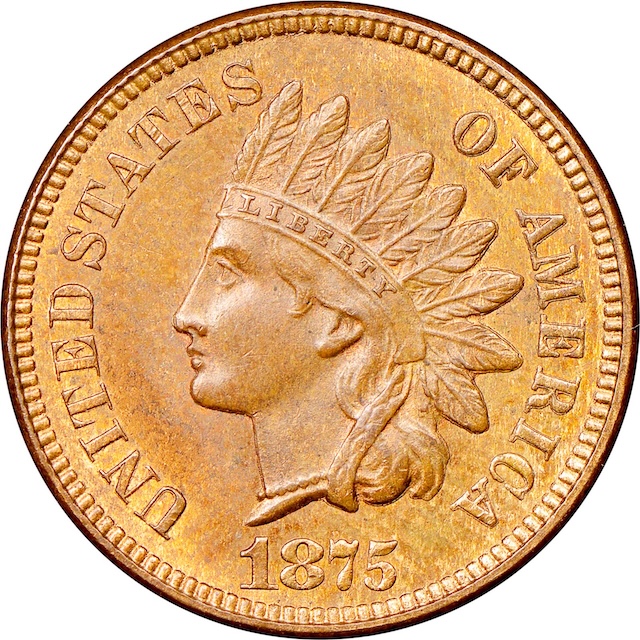
A gem-red 1875 Indian Head cent graded PCGS MS66 Red CAC sold for $16,800 at Heritage Auctions in March 2025 — yet worn examples still start around face value. Discover where yours falls with our free tools below.
Signature Variety Identifier
The Dot-on-N (FS-801, Snow-16) is the most famous 1875 Indian Head cent variety — a deliberate die alteration placed by mint officials to catch a coin thief. Check whether your coin has this rare feature.
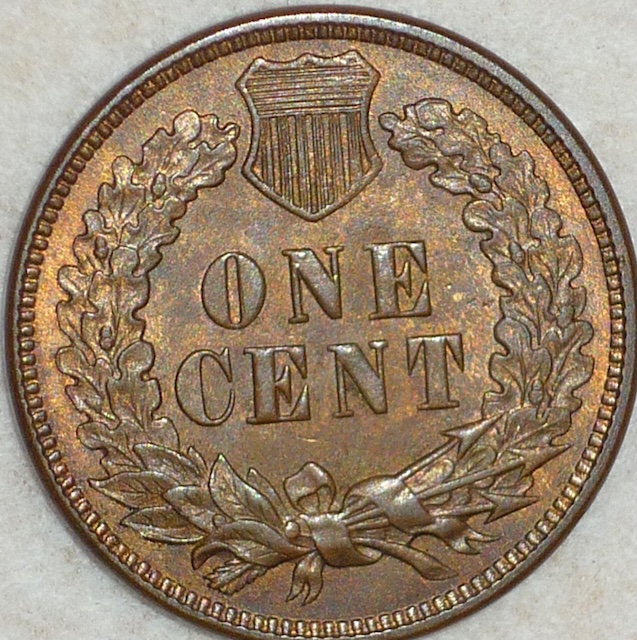
The letter N in ONE is clean with no raised features on its crossbar or top serif. Die lines and other minor oddities may appear on heavily used dies but the N remains free of any raised dot. This is the common reverse found on the vast majority of 1875 cents.
A small but distinctly raised circular dot sits at the top-center of the crossbar of the N in ONE. This dot was deliberately cut into the die by mint coiner A. Loudon Snowden in August 1875 to identify stolen coins. Fewer than a handful of examples are documented in major grading service populations.
Detailed Assessment Tool
Tell us what you see on your coin in plain language — our analyzer will identify possible varieties, estimate condition, and give you a personalized value range.
Described your coin but want an instant dollar estimate? The calculator gives you a specific value in seconds.
Run the Value Calculator →Free Instant Tool
Work through the three steps below to get an estimated value range for your coin. All values are based on PCGS auction data and recent Heritage Auctions results through 2026.
Step 1 of 3 — Select Mint Mark
All 1875 Indian Head cents were struck at Philadelphia — there is no mint mark. Select the only option below to proceed.
Step 2 of 3 — Select Condition
Step 3 of 3 — Error / Variety
If you're not yet sure of your coin's condition or whether it has an error variety, there's a 1875 Indian Head Penny Coin Value Checker online tool that lets you upload a photo and receive an AI-assisted identification before using this calculator.
Jump to any section:
Complete Reference
The 1875 Indian Head cent is home to one of the most historically documented die alterations in U.S. numismatics — the legendary Dot-on-N, placed by a mint official to trap a thief. Beyond that showstopper, the date harbors several PCGS-recognized Repunched Date varieties and dramatic die-line oddities. The cards below cover each major collectible variety in descending order of premium value.
This is the single most important 1875 Indian Head cent variety, historically and numismatically. In August 1875, mint coiner A. Loudon Snowden suspected an elderly employee named George Mitchell of stealing cents from the coining room. Snowden arranged for a die to be secretly altered — a small dot cut into the reverse die on the letter N in ONE — so that struck coins could be identified as "marked." Mitchell was caught, confessed, and dismissed after 50+ years of service.
The diagnostic feature is a small but distinctly raised circular dot at the top-center of the N's crossbar in ONE on the reverse. This is not a die line, a pit, or a scratch — it is a die characteristic present on every coin struck from that die. Under a 10× loupe the dot appears round and symmetrical, elevated above the surrounding die-polished field. Normal 1875 reverse dies show a clean N with no raised features.
Because few coins were struck from the altered die before the investigation concluded and the die was retired, known examples are genuinely rare. PCGS population data lists only a handful of certified attributions, and coins graded MS-64+ Red represent top-tier examples. Collectors pay a significant premium — five to ten times comparable standard coins — for certified Snow-16 pieces. The variety is listed in the Cherrypickers' Guide (FS-801), Rick Snow's Indian Cent reference, and A Guide Book of United States Coins.
During the mid-Victorian era, die dates on U.S. coins were entered by hand using individual digit punches. A punch was placed against the working die and struck into the steel with a hammer. If the punch was misaligned on the first blow, it was re-struck in the correct position — leaving a faint ghost impression of the first punch alongside the final, properly placed digit. The FS-302 (Snow-2) is the most visually dramatic repunched date among the three major 1875 RPD varieties.
On FS-302, the original date impression is clearly displaced to the west of the final date position. Under a 10× loupe, look for a ghost of the 1, 8, and 5 digits slightly to the left (west) of the primary date numerals. The repunching is particularly clear on the 8 and 5, where the earlier impression appears as a secondary outline or serif doubling. The 1 digit may also show a ghosted upper serif to the northwest of the primary 1.
This variety is recognized by PCGS and listed in major Fivaz-Stanton reference works. It is the most commonly encountered of the three 1875 RPD varieties in certified populations, making it the benchmark for the RPD type. An AU-58 PCGS example sold for $255 in January 2026. In EF condition, certified examples typically bring around $95–$130 over the standard coin price, with uncirculated pieces commanding several hundred dollars.
FS-301 is the first of the three formally catalogued 1875 Repunched Date varieties in the Fivaz-Stanton Cherrypickers' Guide. Like all RPDs from this era, it originated when a die-setter misaligned a date punch on the first strike and had to re-punch the digit in the correct position, leaving traces of the initial, off-center impression embedded in the die steel.
The diagnostic for FS-301 (Snow-1) is repunching visible primarily within the loops of the 8 digit. Under a 10× loupe, the inner curves of both loops of the 8 show a secondary impression — the earlier punch impression appears as a slight secondary curve or flat area inside the normal loop shape. Some references also describe subtle repunching on the adjacent 1 digit's upper serif. The repunching on this variety is subtler than FS-302, which is part of why specialist attribution is recommended.
This variety is pursued by specialists building complete sets of 1875 RPD varieties and by Cherrypickers' Guide enthusiasts who examine raw coins in dealer stocks. Its relative subtlety compared to FS-302 means it is somewhat less frequently attributed, but PCGS and NGC will certify and attribute it. Premiums in EF grades typically run $50–$100 over base value for standard coins, rising to several hundred dollars in quality uncirculated pieces — particularly those retaining some original red color designation.
The ODD-004 variety (Snow-18 in Rick Snow's reference) is an obverse die oddity characterized by heavy raised die lines below Liberty's ear, across the jaw, and through the eye area. These lines were produced by die-file marks — tool marks left by mint workers who used files to polish or repair die surfaces during the production process. When a file was dragged across the die steel to remove a die defect or smooth a surface, it left parallel grooves in the die that transferred as raised lines onto every coin struck from that die.
On ODD-004, the die lines below the ear and jaw area are particularly heavy and numerous. Under a 10× loupe, they appear as fine parallel raised lines cutting across the field below Liberty's ear, sometimes extending upward through the jaw and even through the eye region of the portrait. Complementary die cracks are also noted on this die, radiating from several clock positions around the design, including notable cracks from 3:00, 7:45, 8:45, and 11:30. A die break between middle and lower olive leaves on the reverse of the later die state (L.2) further identifies more advanced examples.
While the premium for this variety is modest compared to Snow-16 or certified RPDs, it represents an excellent "cherry-pick" target for collectors who examine raw 1875 cents with a loupe. The distinctive die lines make attribution straightforward once the collector knows what to look for. Examples in EF condition showing strong die lines are genuinely appealing to specialists and can trade for meaningful premiums above standard base values for the date. The variety is documented by indiancentvarieties.com and Rick Snow's two-volume Indian Cent reference.
Found one of these error varieties on your coin? Get a specific dollar estimate with the free calculator — just select your mint, condition, and variety in under 60 seconds.
Calculate My Coin's Value →Quick Reference
For a complete illustrated 1875 Indian Head penny identification breakdown with photo grading examples, bookmark that resource alongside this chart. The table below summarizes estimated values for each major variety across all four condition tiers, based on PCGS auction data and Heritage Auctions results through early 2026. All values are for certified, problem-free coins.
| Variety | Worn (G–F) | Circulated (VF–EF) | Uncirculated (MS-60–64) | Gem (MS-65+) |
|---|---|---|---|---|
| Standard 1875 (BN) | $24 – $90 | $90 – $220 | $295 – $750 | $1,550 – $16,800 |
| Dot-on-N Snow-16 FS-801 SIGNATURE | $200 – $400 | $500 – $1,800 | $2,000 – $4,200 | $4,200+ |
| RPD FS-302 Snow-2 RAREST RPD | $30 – $100 | $95 – $275 | $300 – $800 | $800+ |
| RPD FS-301 Snow-1 | $25 – $90 | $85 – $250 | $280 – $700 | $700+ |
| Die Lines ODD-004 Snow-18 | $25 – $60 | $50 – $200 | $200 – $500 | $500+ |
| Proof (PR-63 to PR-66 RD) | — | $210 – $500 | $500 – $5,000 | $5,000 – $26,400 |
* Gem MS-65+ Red (RD) examples command the highest premiums. The $16,800 sale was a PCGS MS66 RD CAC business strike (Heritage Auctions, March 2025). The $26,400 figure is a documented proof record. All values assume certified, problem-free coins with no cleaning, corrosion, or damage.
📱 CoinHix lets you scan your 1875 Indian Head cent on the go and instantly cross-check estimated values against recent auction data — a coin identifier and value app.
Production Records
| Mint | Mint Mark | Business Strike Mintage | Proof Mintage | Notes |
|---|---|---|---|---|
| Philadelphia | None | 13,528,000 | ~700 | Only mint producing Indian cents in 1875 |
| Total | — | 13,528,000 | ~700 | All Philadelphia production |
Grading Reference
Grade Tier 1
Worn (G–F-12)
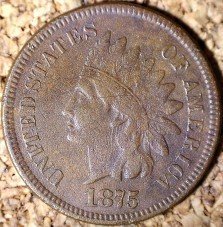
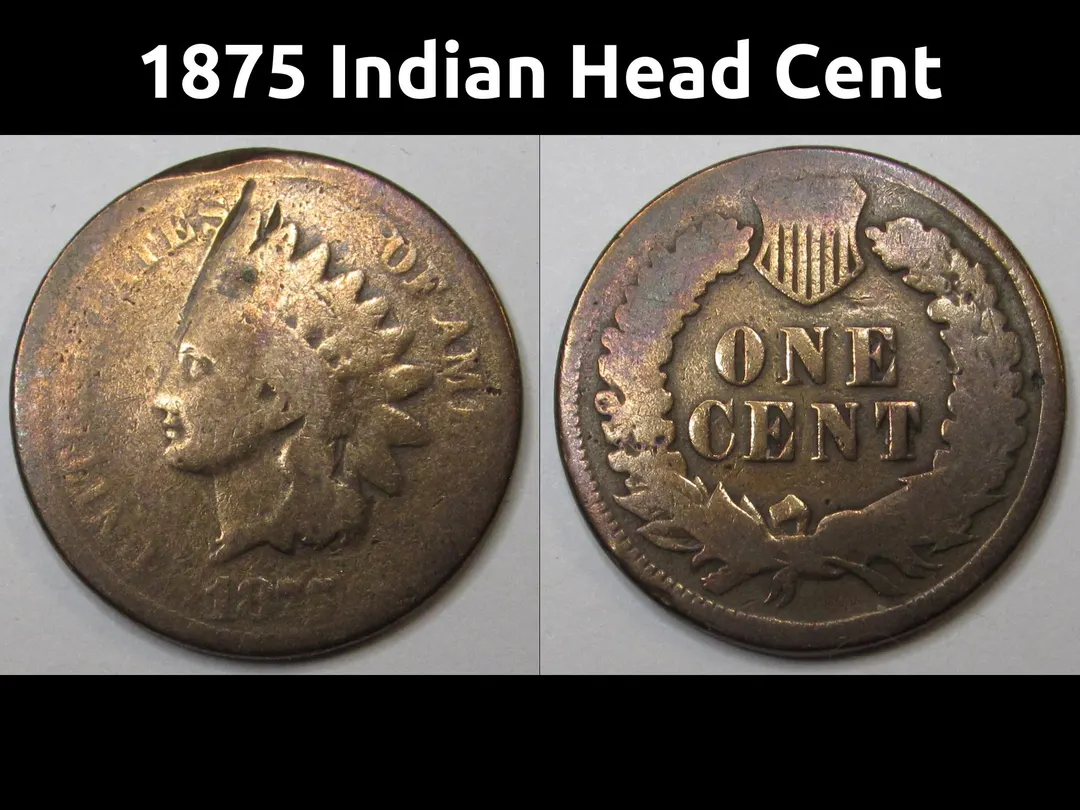
Heavy circulation wear has flattened most design details. The portrait outline and date remain visible but LIBERTY in the headband may be partially or fully worn away at lower grades. The wreath and ONE CENT lettering are present but flat. Surface often shows dark original patina. Value range: approximately $24–$90.
Grade Tier 2
Circulated (VF–EF-45)
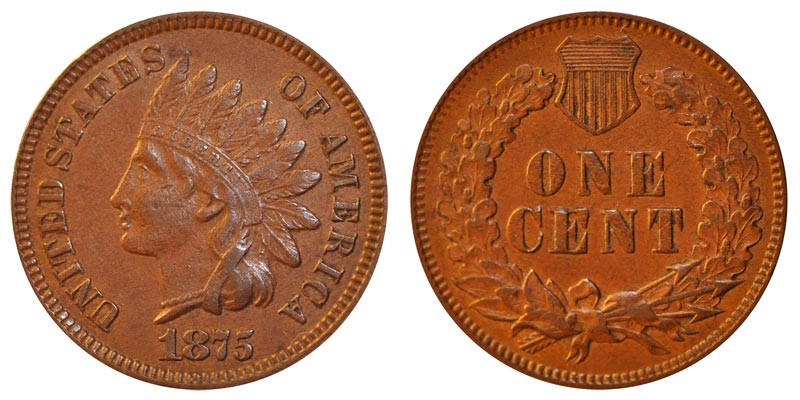
Moderate to light wear with good overall detail. LIBERTY is fully readable. Feather tips show some flatness but most remain separated. In EF, only the very highest points — feather tips, cheekbone, ribbon knot — show slight smoothing. Luster is gone but the coin retains a pleasing, even tone. Value: approximately $90–$220.
Grade Tier 3
Uncirculated (MS-60–64)
No trace of circulation wear. Full cartwheel luster present. Contact marks (bag marks) may be visible but do not indicate wear — coins were stored in mint bags and contacted each other before release. Color designation (BN, RB, or RD) critically affects value. MS-62 BN examples sell for $200–$320; MS-64 RB examples bring $500–$1,000.
Grade Tier 4
Gem (MS-65+)
Superior luster, minimal contact marks visible only under magnification, and sharp strike across all design elements. For 1875, gem status is rare — especially with Red color designation. MS-65 RD coins are very scarce in PCGS and NGC populations. An MS-66 RD CAC example sold for $16,800 in March 2025 at Heritage Auctions. An MS-66 RB brought $4,320 in June 2024.
🔎 CoinHix lets you compare your coin's surface against graded examples to match condition tier and color designation — a coin identifier and value app.
Selling Guide
The right venue depends on your coin's grade and variety. High-grade or error coins belong at major auction houses; mid-range examples work well on eBay; worn circulated pieces are best sold locally or in lots.
The premier choice for high-grade 1875 cents — especially Gem MS-65+ examples, Proof coins, and any Snow-16 Dot-on-N specimens. Heritage consistently achieves strong premiums for Indian cents in their regular U.S. coin sessions. The March 2025 sale of an MS66 RD CAC for $16,800 occurred here. Minimum consignment thresholds apply; contact Heritage directly for current requirements.
The largest audience for mid-range 1875 Indian Head cents in the VF–AU and lower MS grades. Recent sold prices for 1875 Indian Head pennies at current auction results show VF-35 examples bringing $85–$170 and AU-55 examples realizing $170–$220. Always list certified (PCGS/NGC) coins in their original slabs with clear photographs of both sides. Use Completed Listings to set a realistic starting price.
Best for circulated examples you want to sell quickly. Expect a dealer to offer 50–65% of retail value for raw coins, and 65–75% of retail for certified pieces, depending on the shop and current demand. Bring comparable sold listings from eBay or Heritage to support your asking price. Local shops often pay fair premiums for better dates like the 1875 in comparison to common Lincoln cents.
A collector-to-collector marketplace where you can often achieve closer to retail pricing than a dealer buylist. The r/Coins4Sale and r/CoinSwap communities include serious Indian cent collectors. Post clear macro photographs and disclose any known issues or PCGS/NGC grades. Payments via PayPal Goods and Services protect both parties. Best for coins in the $30–$300 range.
Frequently Asked Questions
The free calculator takes under 60 seconds — no signup, no email, instant results based on real auction data.
Calculate My Coin's Value Now →